There is no single best cold calling agency: the right one is the agency whose billing model, callers and reporting fit your deal size and your stage. Published prices checked on November 11, 2026 run from $1,998 a month for a calls-only plan to $11,950 per four-week period for one dedicated SDR, and most agencies publish no price at all. Score every candidate on the same 12 criteria, start with a 90-day pilot, and judge it on held meetings your sales team accepts, never on dials.
You’re probably here because…
What does a cold calling agency actually do?
“Cold calling agency” covers six different services. Vendors use the words interchangeably, which is the first reason quotes are impossible to compare. Before you ask for a price, decide which of these you are buying.
Two things sit outside the scope. A call center that sells to consumers follows different rules and a different economy. And an agency whose core channel is email is not a calling agency, even if “calls” appears in its menu: if that is what you need, a done-for-you firm such as Danish Lead Co, which runs cold email outreach for B2B companies, is a different purchase from the ones compared here. Our guide to cold call versus cold email helps you decide which channel deserves the budget.
Before you ask for a price, decide which service you are buying. Two quotes for “cold calling” can describe a caller reading your script and a team that owns your whole top of funnel.
How do cold calling agencies charge?
Almost every quote fits one of three billing models. None is better in itself. Each one decides who loses money when meetings do not come, and what the agency is rewarded for.
-
Monthly retainer
a fixed amount per month or per period
- You pay for
- caller time and a volume of dials
- The agency is pushed to
- hit the promised activity and keep you for a long time
- Write into the contract
- the number of days or dials, and a checkpoint with a right to exit
-
Hybrid
a lower fixed fee plus a variable part
- You pay for
- a base of activity, then each held meeting
- The agency is pushed to
- produce meetings without drifting off target
- Write into the contract
- what the fixed fee covers, and what triggers the variable
-
Pay per meeting
a price per meeting delivered
- You pay for
- each meeting, as defined in the contract
- The agency is pushed to
- deliver fast and in volume, sometimes at the cost of qualification
- Write into the contract
- the definition of a qualified meeting and what happens to no-shows
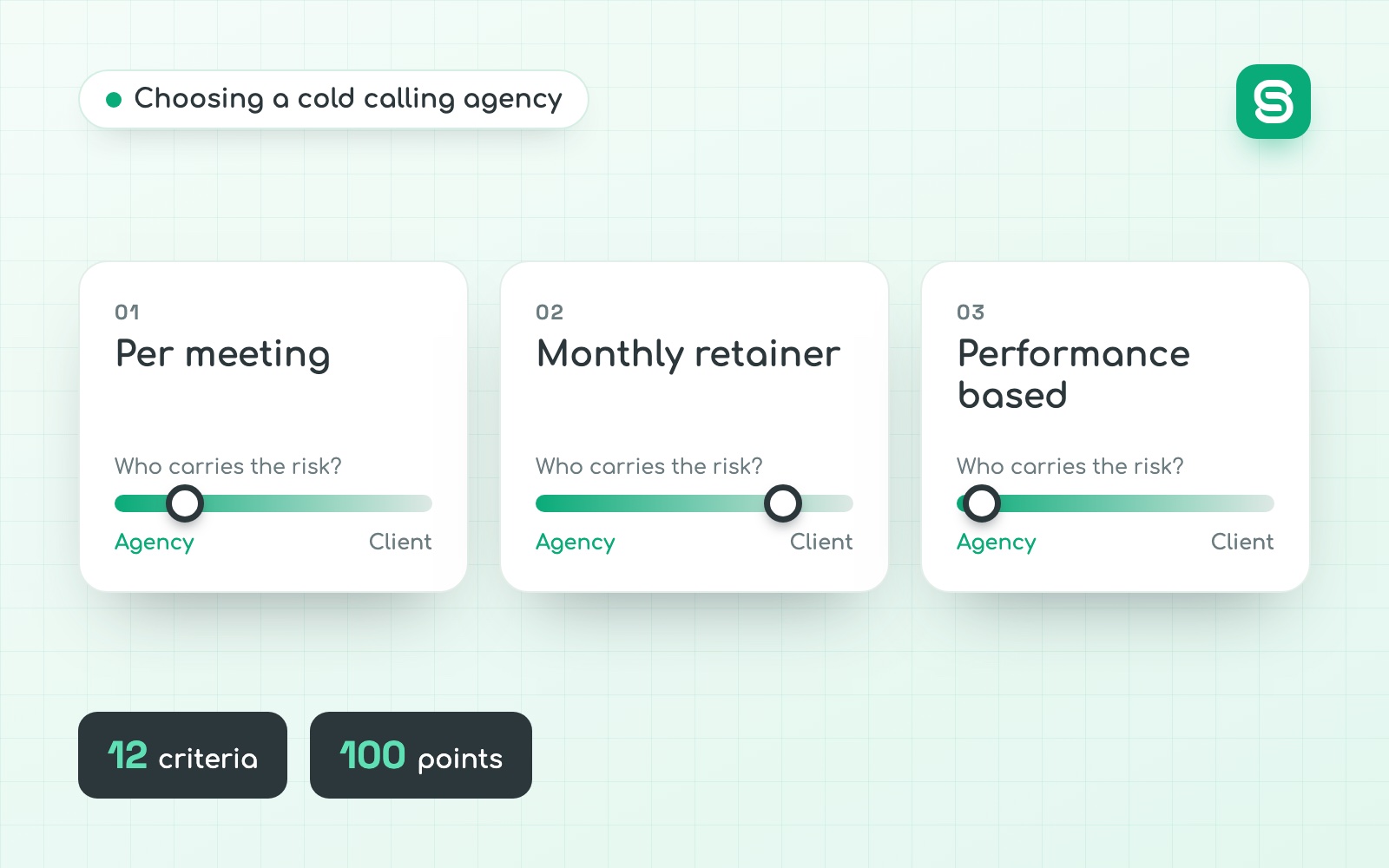
How to read it: the further left the marker, the more you pay even if meetings do not come; the further right, the more the agency is paid on results, and the more precisely the result has to be defined. Illustrative diagram, not a measurement.
- A predictable cost you can budget for a quarter
- The agency can afford to qualify hard and say no to weak meetings
- Works when the sales cycle is long and each meeting is worth a lot
- You pay the same amount for a full calendar and an empty one
- Activity reports can replace results if the contract only counts dials
- Hard to stop mid-term without a pilot clause
- You pay for an outcome, so an empty month costs little
- Easy to compare with your own cost per meeting
- Useful for a simple offer with a wide, reachable market
- The agency is pushed toward volume, and the easiest meeting to book is the least qualified
- Everything depends on the wording of “qualified” and on the no-show rule
- Agencies decline this model for hard targets, or price the risk into each meeting
The hybrid model, a lower fixed fee plus a price per held meeting, is often the fairest for both sides once the first months have shown what a normal month looks like. It is also the hardest to negotiate before any data exists, which is one more reason to start with a pilot.
The wording of the result matters more than the unit price. Here is the same month under three definitions, with an illustrative price of $300 per meeting chosen only to make the arithmetic visible.
An agency will rarely accept “accepted by the client” without a written list of criteria, and it is right: otherwise you could refuse every meeting. The workable middle is “held, and matching the criteria in appendix A”, with the criteria agreed before the first call.
How much do cold calling services cost in 2026?
Most agencies do not print a price. Of the seven US-facing agencies in the directory below, three publish an amount somewhere on their own site. These are the figures we read on November 11, 2026.
Leadium’s pricing page shows no program price, but an article on its own blog lists its cold calling program at $3,500 a month and its multichannel program at $4,000 to $5,000 a month. Belkins describes “monthly retainer packages” without amounts. Callbox, memoryBlue and SalesHive quote after a scoping call; SalesHive’s page states that plans are priced by team location, channels and daily outreach volume.
Three reading notes before you compare these numbers with a quote.
We deliberately give no “market average” for the price of a meeting. The ranges that circulate online are estimates published by vendors, rarely with a method. The only cost per meeting you can trust is the one you compute from a real invoice and a real count of held meetings, which the next section shows how to do.
Should you outsource cold calling or hire an SDR?
The honest comparison is cost per held meeting over a year, with ramp time included on both sides. Here is the math with every assumption on the table, so you can replace each one with your own number.
The 12 meetings a month and the three-month ramp are working assumptions, not benchmarks. For sourced connect and conversion figures, see our page of cold calling statistics. Your own ratio depends on your list and your offer; our article on how many cold calls it takes to book a meeting shows how to estimate it, and the free in-house vs outsourced SDR calculator runs the full comparison with hiring cost and turnover included. For the salary side, see the SDR salary benchmarks for the US.
Cost is only one side. The two options do not buy the same thing.
Does it matter where the callers are based?
Yes, and it is one of the main levers behind a quote. Several agencies sell the same plan with callers in the United States or abroad: SalesHive’s pricing page, for instance, offers its tiers with US-based or offshore SDRs, the offshore ones at a lower monthly rate with a US-based strategist. Neither option is better in itself. What changes is worth checking on four points.
When is an agency the wrong answer?
An agency multiplies a message that already works. It does not find the message for you. Four situations where the money is better kept:
- Nobody has sold the offer by phone yet. Make the first fifty calls yourself, or have a founder make them. You will write a better brief, and you will know what a normal conversation sounds like.
- The deal is too small. When one sale brings less than a few meetings cost, no billing model fixes the math. The thresholds by deal size are in our guide on whether to hire an SDR.
- Sales cannot absorb the meetings. Ten extra meetings a month need someone available to hold them within days. Meetings that wait go cold.
- There is no list. If you cannot describe the accounts to call, the agency will choose them, and you will pay for its guess.
There is also a third path that the agency-versus-hire debate hides: getting more conversations out of the callers you already have. A rep who spends most of the day listening to ringing is an expensive rep, in-house or outsourced. Our playbooks on scaling an SDR team without hiring and on reducing the cost per meeting cover that route, and turnover alone can change the math, as the guide to SDR turnover shows.
How do you evaluate a cold calling agency?
Sales calls with agencies all sound alike, because every agency has good callers, a proven process and happy clients. The way out is to score each candidate on the same grid, with weights decided before the first call. This is the grid we would use.
- 10 Callers employed and dedicated You know who calls, for how many clients, and from which country
- 8 Training and coaching A described onboarding path and call reviews every week
- 7 Experience with your industry Campaigns run on buyers close to yours, with references to back it
- 10 List source and freshness The contact source is named, and you keep the worked list
- 10 Script and qualification rules A script written with you and a written definition of a qualified meeting
- 8 Caller numbers and compliance Numbers dedicated to your campaign and calling rules in writing
- 10 Access to recordings You can listen to the calls of your own campaign, not a highlight reel
- 9 Reporting in held meetings The report talks about conversations and held meetings, not dials
- 6 References you can call Two current clients you can phone yourself
- 10 Meeting definition and no-shows Criteria are written down, and a no-show is replaced or not billed
- 7 Term and exit A bounded pilot, then a short notice period
- 5 Ownership of list, numbers and script Everything the campaign produces comes back to you at the end
Score each criterion from 0 to 5, multiply by its weight, then divide the total by 5 to get a mark out of 100. The weights are our suggestion: move them to fit what matters to you, but keep the same grid for every agency you talk to.
A few of these criteria deserve a longer look, because they are the ones buyers skip.
Who actually calls. “Dedicated” has two meanings: a rep who works only on your account, or a team dedicated to your account among others. SalesRoads, for example, writes “100% dedicated rep, never shared across accounts” on its pricing page. Ask every agency for the same sentence, plus the caller’s location and employment status.
How callers are trained. Ask what a new caller does before the first live dial, and how often calls are reviewed afterward. An agency that rehearses openers and objections will be able to describe it; our cold call role play scenarios show what that practice looks like.
Where the list comes from. A call campaign is only as good as the numbers dialed. Ask for the data source by name, the share of direct dials and mobiles, and who keeps the worked list at the end. Our guide to B2B lead lists for cold calling explains what a callable list looks like.
Which numbers are displayed. If the agency calls hundreds of your prospects from numbers already flagged as spam, your answer rate falls before the script is even heard. Ask whether the caller numbers are dedicated to your campaign and what happens when one is flagged. The mechanics are in our article on caller ID marked as spam.
How the report is built. A weekly report should start with conversations and held meetings, then go back up the funnel. Dials come last. The metrics worth tracking are in our guide to SDR metrics and KPIs.
What questions should you ask a cold calling agency before signing?
Send the questions in writing, before the demo. Written answers can be compared across agencies and attached to the contract; spoken ones cannot. Here is a message you can copy.
An agency that answers all ten in writing is selling a process. An agency that answers “we will go through that on the call” is selling a call. Point 8 depends on where your prospects are: the rules differ from one country to the next, as our overview of cold calling laws by country shows, and US programs should be read against the TCPA rule changes. The agency places the calls, but the campaign carries your name.
Which contract clauses matter most?
A proposal sells the upside. The contract decides what happens in a bad month. These are the clauses to read twice, in the order in which they cause disputes.
- 01
The definition of a qualified meeting
Job title, company size, country, stated need, and whether the prospect knows what the meeting is about. If the definition fits on one line, it is not a definition. Borrow the criteria from your own lead qualification rules.
- 02
The no-show policy
A booked meeting and a held meeting are two different products. Write down whether a no-show is replaced, credited or billed, and after how many rescheduling attempts.
- 03
The pilot and the decision point
A bounded first period, with the numbers that will be reviewed at the end and the right to stop without penalty if they are not met.
- 04
Term and notice
Month to month, quarterly or annual, and how many days of notice. Several agencies advertise no long-term commitment: get the notice period in the contract, not in the sales deck.
- 05
Ownership of the list and the call data
The worked list, the call outcomes, the notes and the recordings should come back to you. Otherwise you pay twice for the same market: once to the agency, once to rebuild what it learned.
- 06
Caller numbers
Who owns the numbers displayed to your prospects, and can you keep them? A number that prospects have learned to recognize has value.
- 07
Compliance and recording
Who checks do-not-call lists, who handles opt-outs, and how recordings are announced and stored. The basics of call recording laws apply to an outsourced campaign as much as to your own.
- 08
Hiring the rep
If a caller turns out to be excellent, can you hire them, and at what fee? Some agencies make this a feature: memoryBlue states on its site that clients can hire its reps onto their own team.
What are the red flags when choosing a cold calling agency?
None of these is proof of a bad agency. Each one is a reason to slow down and ask for something in writing.
What mistakes do buyers make with cold calling agencies?
The red flags above are on the agency’s side. These six are on the buyer’s side, and they explain as many failed campaigns. Each one has a simple fix.
- Choosing on the monthly fee instead of the cost per held meeting
- Handing over a one-paragraph brief
- Reading the report and never listening to a call
- Leaving booked meetings unconfirmed for days
- Changing target, script and calling hours in the same week
- Treating the agency as a vendor that has nothing to teach you
- Divide every invoice by the meetings actually held
- Fill in the one-page brief further down: it takes an hour
- Listen to ten recordings a week during the first month
- Set a response time for your own sales team, and keep it
- Change one thing at a time and measure it over two weeks
- Ask the callers each month what prospects object to
A cheap retainer with two held meetings costs more per meeting than an expensive one with twelve. And the callers hear your market every day: what they report about objections is often worth more than the dashboard.
A directory of seven cold calling agencies, in alphabetical order
This directory is not a ranking and gives no rating. Each card contains only what the agency states on its own website, read on November 11, 2026, with “not published” where the page is silent. The seven names are agencies that sell outbound calling to US B2B companies and that publish enough to be described. Being listed is not a recommendation, and being absent means nothing.
Belkins
- Service
- Appointment setting on monthly retainer packages
- Channels
- Cold email and LinkedIn on every package; intent-based cold calling on Growth; cold calling and voicemails on Growth Plus only
- Published price
- Not published
- Stated volume
- 100+ yearly appointments (Growth), 200+ (Growth Plus)
- Term
- Not published
Callbox
- Service
- Managed B2B lead generation
- Channels
- Phone, email, LinkedIn, web, chat and events
- Published price
- Not published; scope depends on market, channels and languages
- Regions
- North America, Asia-Pacific, Europe and UK, Latin America
- Term
- Not published
Leadium
- Service
- Outsourced appointment setting and lead generation
- Channels
- Cold calling, outbound email, LinkedIn prospecting, gifting
- Published price
- None on the pricing page; its blog lists $3,500 a month for cold calling and $4,000 to $5,000 for multichannel
- Team
- Describes itself as a 100% US-based sales company
- Term
- Month to month, per its FAQ
memoryBlue
- Service
- Dedicated SDRs, ADRs and AEs, plus recruiting
- Channels
- Phone, email and LinkedIn
- Published price
- Not published
- Regions
- North America, EMEA, APAC and LATAM, in 30+ languages
- Worth knowing
- States that clients can hire its reps onto their own team
SalesHive
- Service
- Managed SDR plans: Starter, Growth, Crush
- Channels
- Phone only on Starter; phone and email on Growth and Crush
- Published price
- Not published; quoted by team location, channels and daily volume
- Team
- US-based or offshore SDRs
- Term
- Month to month or annual; states it does not guarantee a number of meetings
SalesRoads
- Service
- Dedicated SDR program with strategist, coach and data team
- Channels
- Outbound calling and email prospecting
- Published price
- $11,950 per four-week period for one SDR; $16,750 for two
- Included
- 500 enriched records per SDR per month, CRM integration, dashboard
- Term
- States no long-term commitment, cancel anytime
Superhuman Prospecting
- Service
- Calls-only subscriptions and SDR bundles
- Channels
- Cold calling; list building sold separately
- Published price
- From $1,998 a month (Calls Only Flex); from $4,995 (Premium SDR Bundle); list building from $3.00 per contact
- Team
- USA-based callers
- Term
- States no long-term commitments on both monthly plans
Sources, all read on November 11, 2026: the pricing pages of Belkins, Leadium, SalesHive, SalesRoads and Superhuman Prospecting, the home pages of Callbox and memoryBlue, and Leadium’s blog article on fractional SDRs for its program prices. Prices and terms change: confirm every line with the agency before you rely on it.
How to use this directory: pick three names whose service type matches what you decided to buy, send each the ten-question message above, and fill in the scorecard from the written answers. The agency with the best website is not always the one with the best answers.
How do you run the first 90 days with a cold calling agency?
A pilot only teaches you something if both sides agreed, before the first dial, on what will be measured at the end. Here is a plan that fits a 90-day pilot.
- 01
Before day 1: the brief
One page with your target, your offer, the objections you already hear, three accounts you won and why, and the definition of a qualified meeting. The template is below.
- 02
Weeks 1 and 2: setup
List validated line by line on a sample, script approved, caller numbers assigned, CRM access and calendar connected. No calls to your best accounts yet.
- 03
Weeks 3 to 5: calibration
Listen to ten recordings a week with the agency. Change one thing at a time: the opener, the target, or the calling hours. Refuse the first off-target meeting in writing, so the rule is set early.
- 04
Weeks 6 to 10: steady state
The calendar should fill at a regular pace. Track held meetings, the share your sales team accepts, and the first opportunities created.
- 05
Weeks 11 to 13: decision
Compute the cost per held meeting and per accepted meeting from the invoices. Compare with the in-house threshold from the math above. Continue, renegotiate the model, or stop.
Three numbers are enough to run the weekly review.
To review the calls themselves on a common basis, the free sales call scorecard gives you a grid, and the cost per meeting calculator does the last division for you.
The brief to send your agency (copy it)
Most disappointing campaigns start with a thin brief: the agency fills the gaps with assumptions, and the first three weeks are spent discovering them. This template takes an hour to complete and saves a month.
Where does Skipcall fit?

Skipcall is not an agency and does not make calls for you. It is the calling software that agencies and in-house teams use to make them: a power dialer and a 4-line parallel dialer, with recording, transcripts, AI call summaries and native sync with HubSpot, Pipedrive, Salesforce and Attio.
That matters to an agency buyer in two ways. First, the tool your agency dials with decides how many conversations an hour of caller time produces, and therefore what a meeting costs you: it is fair to ask which one it uses. Our comparison of the best power dialers shows what separates them. Second, a tool that separates clients into workspaces is what makes it possible to hand you the recordings of your own campaign and nobody else’s. If you run an agency yourself, the Skipcall page for prospecting agencies and our comparison of cold calling software for prospecting agencies cover that side.
Skipcall will not help if what you need is someone to pick up the phone on your behalf next Monday. That is what the agencies above are for.
What to remember
- “Cold calling agency” covers at least six services. Decide which one you are buying before comparing prices.
- The billing model decides who carries the risk. A retainer puts it on you, pay per meeting puts it on the definition of a meeting, a hybrid splits it.
- Published prices are the exception. The ones we found on November 11, 2026 range from $1,998 a month to $11,950 per four-week period.
- Compare on cost per held meeting, ramp included. A $5,000 retainer beats a first-year hire from 4 held meetings a month, under the assumptions shown above.
- Score every agency on the same 12 criteria, in writing, and ask for recordings of your own campaign.
- Sign a 90-day pilot with a decision point, a definition of the qualified meeting and a no-show rule. Everything else can be negotiated later.